
What It Actually Costs to Furnish a Commercial Office

We incorporated a bold mural painted by a local artist in the Lemonade Insurance HQ in Old Town Scottsdale. This piece brings life to the space.
Furnishing a commercial office can cost anywhere from about $7,000 to $25,000 per person, and where you land inside that range is a choice rather than a fact. Most growing companies I work with end up near $11,000 to $16,000 per person once freight, installation and sales tax are counted, which works out to roughly $60 to $95 per square foot installed.
That is the short answer. Below is where those numbers come from, how the tiers actually differ, and what to do if your budget is nowhere near any of this, because plenty of good companies are in that position and there are real options.
Why nobody will tell you this on the phone
If you have started calling around, you have probably noticed that everyone wants a walkthrough before they will say a word about money.
There is a reason, and it is not mysterious. Most companies who quote office furniture are furniture dealers. Their design work is free because the product carries it, which means the product price is the only place their margin lives. Publishing real numbers is the last thing they want to do.
I am not a dealer. I run an independent design studio in Phoenix, and I have spent fifteen years specifying furniture across every line instead of one catalog. My fee does not move based on where you buy, so I have nothing riding on you not knowing what things cost.
So here is what things cost.
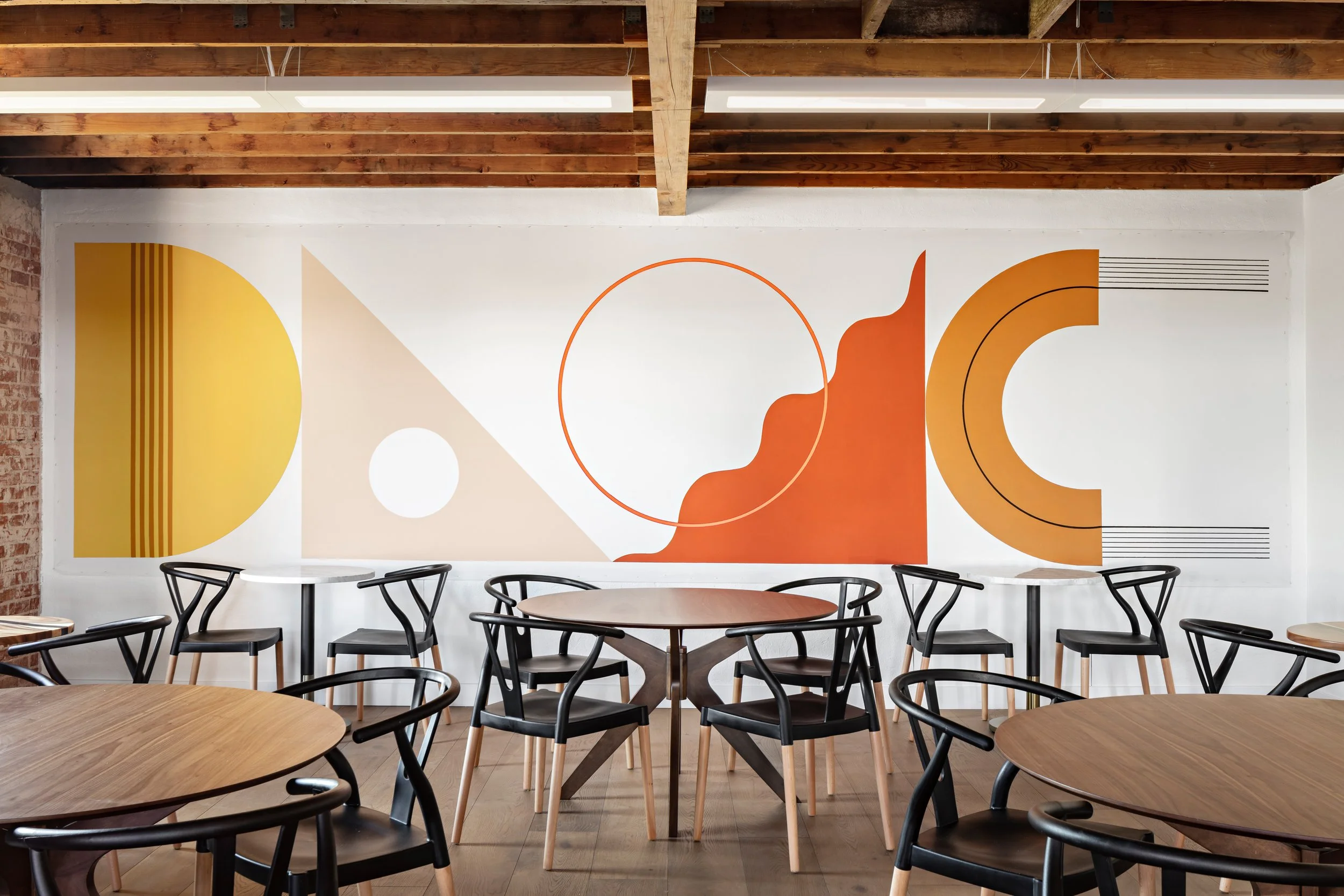
A break area at our Lemonade Insurance HQ office project in Old Town Scottsdale doubles as a perfect spot for all-hands meetings when WFH staff are in office.
First, the three tiers
Every number in this post comes in three versions, so it helps to know what the three mean before you look at any of them. The same room genuinely can be furnished three ways, and the differences are real.
Entry level is what you order online and put on a truck next week. Amazon Business, Wayfair Professional, Article, IKEA. It looks fine on day one. Plan on replacing most of it in five to seven years, and plan on some of it not surviving a move.
Mid-range is contract-adjacent furniture from companies like West Elm Contract, Room & Board Business Interiors and Blu Dot. Built for a workplace, photographs beautifully, and the softer pieces actually feel like somewhere a person wants to sit. This is where most growing companies land, and usually where I recommend they land.
Contract grade is Steelcase, HON, Knoll, Herman Miller, Bernhardt Design. Twelve year warranties, parts you can still order in year eight, and task chairs that survive eight hours a day for a decade. Roughly double the mid-range tier, and worth it in the rooms that take a beating.
The honest answer for most offices is a mix. Contract grade for task seating and workstations, which absorb the most wear. Mid-range for the rooms people visit rather than occupy. There is no rule that the whole building has to match, and no single manufacturer does both of those things well. That is exactly why I am not tied to one.
Every price from here on is listed in that order: entry level first, then mid-range, then contract grade.
Budget per person, not per square foot

This shot from our McKinley Club project in downtown Phoenix highlights a custom steel and glass paneling system that we designed to provide privacy while allowing light to flow through the space. Teh panels were constructed by a local fabricator.
Square footage is how the industry talks. Headcount is how you should actually budget, because a room full of people costs what the people cost, not what the floor measures.
Here is what one fully outfitted seat runs, as of September 2026.
An open plan workstation with a height adjustable bench, task chair, mobile pedestal and dual monitor arms is about $2,200 entry level, $4,750 mid-range, or $8,700 in contract grade.
A panel cubicle with the system, worksurface, overhead storage, task chair, pedestal and monitor arms is about $2,800 entry level, $5,950 mid-range, or $10,700 in contract grade.
A private office with a desk, task chair, credenza, two guest chairs, a bookcase and art is about $3,700 entry level, $8,750 mid-range, or $16,200 in contract grade.
An executive office with a 72 inch desk, executive chair, credenza, two guest chairs, bookcase, rug, lamp and art is about $5,450 entry level, $13,300 mid-range, or $24,800 in contract grade.
If you want a budget in the next ten minutes, multiply your headcount by the mid-range figure for the seat type you use most. You will be in range.
Workstations are almost always the single largest line in a commercial furniture budget, and they are the line that gets underestimated most, because a $900 task chair does not sound like much until you are buying forty of them.
What the shared rooms cost
Seats are the bulk of the budget. These are the rooms that surprise people. Same order as above: entry level, mid-range, contract grade.
A conference room seating ten, with a ten foot table, ten chairs, a credenza and art, runs about $7,500, $18,000, or $33,000. Roughly half of that is the chairs. People flinch at that line and then sit in those chairs four hours a day for the next eight years.
A small conference room seating six is about $5,000, $12,000, or $21,500.
An executive boardroom seating twelve, with a larger table carrying power and data, is about $13,000, $31,000, or $58,000.
A lobby and reception area with a reception desk, task chair, lounge seating, a sofa, tables, a rug, lamps and art is about $10,000, $24,000, or $46,000.
A break room seating around thirty, with café tables and chairs, a banquette run, lounge seating and a buffet, is about $15,000, $35,500, or $65,000. Break rooms are the most consistently underbudgeted room in any office, and in my experience they do more than any other space for whether people want to be in the building.
Two worked examples, both at the mid-range tier
A 15 person office with ten open workstations, three private offices, one executive office, a ten seat conference room, a modest reception and a small break area comes to roughly $137,000 in furniture. Add freight, installation and tax and you are near $177,000 installed, or about $11,800 per person.
A 40 person office with twenty-eight workstations, eight private offices, four executive offices, two conference rooms, a small huddle room, a full break room and two reception areas comes to roughly $380,000 in furniture. Installed, that is near $489,000, or about $12,200 per person.
Notice how stable the per-person number is across two very different buildings. That is why I keep pushing people toward headcount as the planning unit. Square footage moves around based on how generous the floor plate is. People cost what people cost.

Our team works together with the builders and architects to ensure the execution of the project matches the design intent.
The 29 percent almost nobody budgets for
Here is where commercial budgets fall apart.
Every number above is furniture. It is not what lands in your building. On top of that, budget:
About 8 percent for freight and delivery. Commercial furniture ships from manufacturers, not from a warehouse across town.
About 12 percent for receiving, warehousing and installation. Someone takes delivery, stores it while the space finishes, then assembles and places it. That is real labor and it is not optional.
Sales tax, which in the Phoenix metro runs a little over 8 percent depending on the city.
That is roughly 29 percent on top of the furniture price. On a $450,000 package that is another $128,000, and I have watched more than one company discover it three weeks before move-in.
When I say $90 per square foot installed, the word installed is doing a great deal of work.

We did a custom wall mural and reception desk at our Equality Health HQ project in the Phoenix Warehouse district.
If your budget is nowhere near any of this
Good. Most of the offices I have loved most were not the most expensive ones, and some of the worst-feeling spaces I have walked into cost a fortune. A budget is a constraint, not a verdict on the company.
Here is what I actually tell people who are working with a fraction of the numbers above.
Buy used for the things that do not wear out, and new for the things that do. Desks, casegoods, filing, bookcases, conference tables and storage age extremely well. A ten year old contract-grade desk is usually better built than a new entry-level one and costs less. Task chairs are the opposite. Upholstery flattens, cylinders fail, and mesh loses tension, so that is the one category where I would rather see you buy new even if it means buying fewer other things.
Phoenix has a genuinely strong used and refurbished office furniture market. There are several established local dealers and liquidators carrying contract-grade pieces from companies that downsized or moved, and remanufactured cubicle systems are a category worth knowing about. You can frequently buy used contract grade for less than new entry level, which means better furniture and a longer life for less money. That is not a compromise, that is a smarter purchase.
Watch for corporate liquidations. When a company leaves a building, the furniture usually has to go quickly and it goes cheap. If you have a six month runway before your move, it is worth having someone watching.
Spend on the five things people actually touch and see. Task chairs, the conference table you will sit at every week, lighting, the break room, and one good rug in reception. Almost everything else can wait, be secondhand, or be simpler than you think.
Paint and lighting are the cheapest transformation in the business. I have watched a space go from grim to genuinely good on paint, a lighting swap and the removal of about a third of the furniture. None of that is a furniture budget.
And you can hire the thinking without hiring the whole project. Our Quickstart design service is $996 and a great entrypoint for access to design without breaking the bank. Our Quick Start engagement exists for exactly this. You get the plan, the layout and the specific product direction, and then you go execute the buying yourself, at whatever price point and from whatever source you want. You are paying for the decisions, not the procurement. For a lot of companies that is the highest-leverage money in the whole project, because the expensive mistakes in an office are almost never about which chair you bought. They are about how the room was laid out.

Our founder and lead designer, Mackenzie Collier presents a colorful materials palette for a commercial project.
Five things I would tell you if you called me tomorrow
Start with headcount, not square footage. How many people sit down, and in what kind of seat. Everything else follows from that.
Choose your tier room by room. Contract grade where the building takes the abuse. Mid-range where people visit rather than live. You do not have to pick one answer for the whole floor.
Plan for churn on day one. Your headcount will change. A workstation standard that can absorb six more people is worth more than a slightly nicer desk, and deciding that at the beginning costs nothing.
Get the specification written before you collect quotes. If the company writing your furniture specification is also the company selling you the furniture, you cannot competitively bid the package, because no two bids will describe the same thing. On a $450,000 package a ten percent spread is $45,000. That is a lot of money to hand over in exchange for a free rendering.
Order earlier than feels necessary. Lead times, not design time, are almost always what pushes a move-in date. Contract furniture with custom finishes can run sixteen weeks or more.
And one more, which is not really about budgets: buy the chairs last and sit in them first. Every single time.
Where these numbers come from
I am Mackenzie Collier. I founded Mackenzie Collier Interiors in Phoenix in 2011, and my team and I have completed more than five hundred projects across residential and commercial work. On the commercial side that includes offices, headquarters, taprooms and adaptive reuse projects such as Lemonade Insurance, Greenwood Brewing, Reshoevn8r, Equality Health, DeSoto and Larder + The Delta.
We price commercial furniture packages nearly every week. The figures here are budgetary and current as of September 2026. Manufacturer pricing moves, tariffs move, and freight moves with fuel, so treat all of it as a planning range rather than a quote. If you want a real number for a real building, that is a conversation worth having.
Frequently asked questions
How much does it cost to furnish an office per square foot? About $60 to $95 per square foot installed at a mid-range specification, including freight, installation and sales tax. Entry level furniture runs closer to $40 per square foot, and true contract grade can reach $165. Figures are current as of September 2026.
How much should I budget per employee for office furniture? Roughly $11,000 to $16,000 per person installed at a mid-range specification. A single open plan workstation with a height adjustable bench, task chair, pedestal and monitor arms is about $4,750 at that tier before freight, installation and tax. At an entry level specification the per person figure drops closer to $7,000.
Is used office furniture worth buying? For desks, casegoods, filing, storage and conference tables, frequently yes. Used contract-grade pieces often cost less than new entry-level ones and last considerably longer. The exception is task seating, where upholstery, cylinders and mesh wear out, and buying new is usually the better call.
Why is commercial office furniture more expensive than residential furniture? It is built and warranted for eight hours of daily use, often for ten to twelve years, and it must meet commercial fire and safety standards residential pieces do not. It also carries freight, receiving and professional installation, which add roughly 20 percent before tax.
Can I hire an interior designer just for the plan and buy the furniture myself? Yes, and for a smaller budget it is often the smartest way to work. You pay for the layout, the specification and the product direction, then execute the purchasing yourself at whatever price point you choose. The costly mistakes in an office are rarely about which chair got bought. They are about how the room was laid out.
Do I need an interior designer if a furniture dealer will do the space plan for free? A dealer's plan is free because the furniture pays for it. The practical consequence is that the specification gets written around the lines that the dealer is authorized to sell, which removes your ability to competitively bid the package. An independent designer writes a specification you can put out to several dealers, and on a package of any size the spread that opens up is usually larger than the design fee.
How long does it take to furnish a commercial office? Plan on ten to sixteen weeks from approved specification to installed, and longer for contract furniture with custom finishes. Lead times, not design time, are almost always the constraint.
What is the most commonly underestimated line in an office furniture budget? Freight, receiving and installation. Together with sales tax they add roughly 29 percent on top of the furniture price, and early budgets frequently leave them out entirely.